Crypto transaction tracing follows stolen funds across the public blockchain — from the victim's wallet through intermediate addresses to the exchange where they cash out. Investigators use heuristics (common-input-ownership, address reuse, timing analysis) and exchange-attribution databases to build a transaction graph and pinpoint the destination, enabling a freeze request before funds are withdrawn.
The blockchain is a public, permanent ledger. Every crypto transaction ever made is visible to anyone with the right tools — including investigators. Crypto transaction tracing is the process of following stolen funds across that ledger, identifying who controls which wallets, and ultimately locating the exchange account where funds land so a freeze can be requested. This guide explains exactly how it works.
Why Crypto Is More Traceable Than Cash
A common misconception is that cryptocurrency is anonymous. It is not — it is pseudonymous. Every transaction is recorded on a public blockchain, permanently, with the exact amount, the sending address, and the receiving address. Unlike cash, you cannot physically destroy a blockchain transaction record.
What this means in practice: a blockchain forensics investigator who has your transaction hash can follow the flow of your funds indefinitely — through hundreds of wallets if necessary — because every hop leaves a permanent, verifiable record. The challenge is not whether funds are visible, but whether the investigator can connect pseudonymous wallet addresses to real-world identities (exchanges, custodians, or individuals).
Every blockchain address involved in a theft is permanently recorded. The investigator's job is not to find the transactions — they are always there — but to identify which known entity (exchange, mixer, darknet market) controls the destination address.
How Crypto Transaction Tracing Works: Step by Step
Step 1 — Input Collection
The trace begins with the victim's transaction data: the transaction hash (TxID) of the theft transaction, the sending wallet address, and the receiving address. This is the entry point for the investigation graph.
Investigators verify this data on-chain using a block explorer (Etherscan, blockchain.com, Tronscan etc.) and import it into a professional graph analysis tool. The tool automatically fetches all subsequent transactions from the receiving address and builds the initial transaction graph.
Step 2 — Transaction Graph Construction
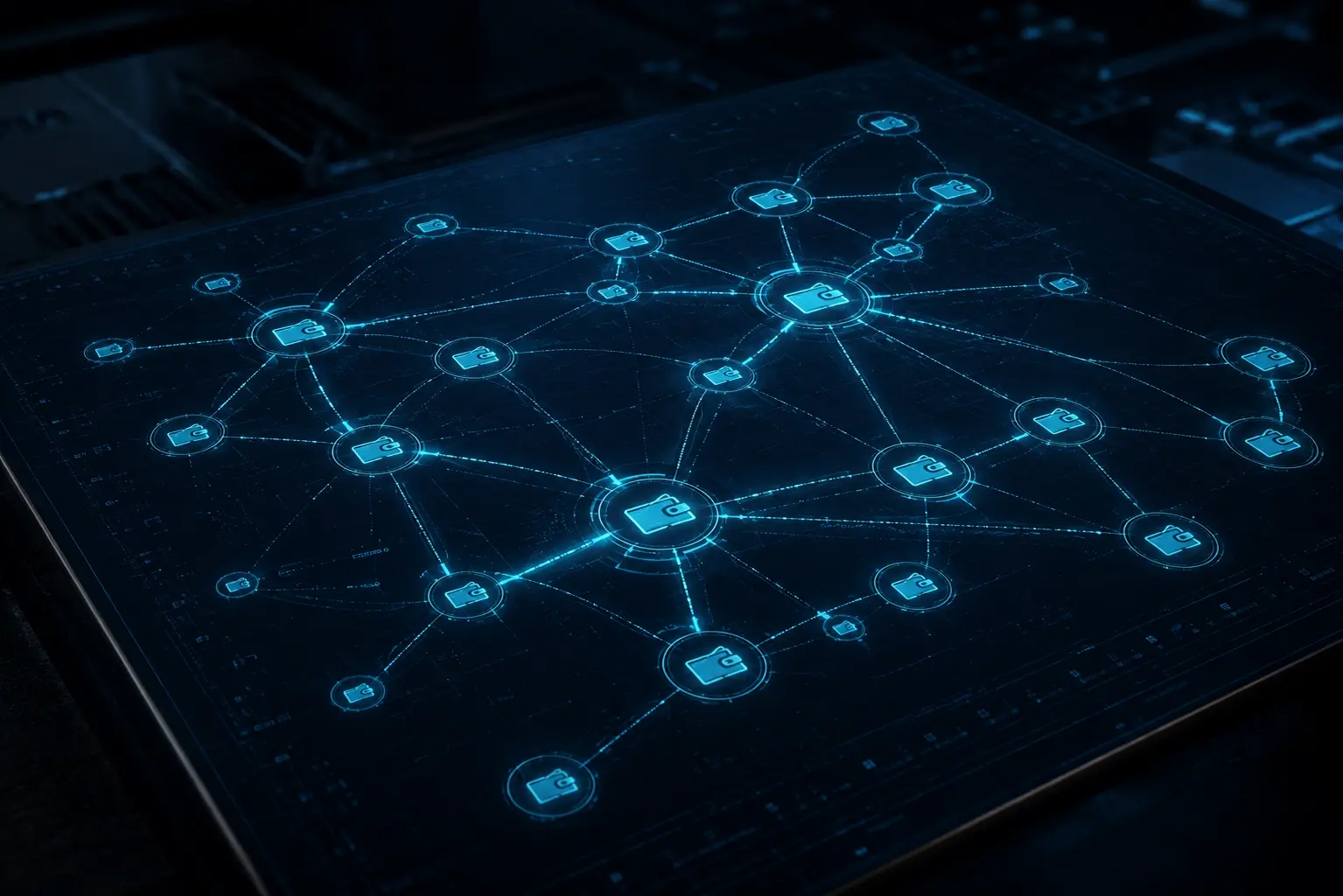
The graph expands automatically with each hop. For each address in the chain, the tool maps all incoming and outgoing transactions, building a visual network of wallets and fund flows. Each node is a wallet address; each edge is a transaction with an amount and timestamp.
Professional tools used by blockchain forensics firms — including Chainalysis Reactor, Elliptic Investigator, and BlockTrace's proprietary attribution layer — can expand a graph to hundreds of nodes in seconds and assign risk scores to each address based on known entity data.
Step 3 — Address Attribution
This is where the investigation becomes powerful. Address attribution databases contain billions of wallet addresses tagged to known entities: exchanges, mixers, darknet markets, sanctions lists, ransomware groups, and scam operations. When a wallet address in the transaction graph matches a known entity, the investigator knows exactly where the funds went.
BlockTrace's attribution layer is built from years of on-chain analysis, exchange deposit address scraping, court-obtained disclosures, and cross-referencing with commercial blockchain intelligence databases. When funds reach an exchange, we can typically identify the specific exchange within hours — sometimes faster than the attacker expects.
Step 4 — Heuristic Analysis
When attacker wallets are not yet in any attribution database (i.e., freshly generated), investigators use heuristics to cluster addresses and infer control:
Common-Input-Ownership Heuristic (Bitcoin)
When multiple inputs are spent in a single Bitcoin transaction, they are almost always controlled by the same entity (since signing requires the private key for each input). This allows investigators to cluster multiple addresses under one entity even if they were never publicly linked.
Address Reuse Analysis
Attackers who reuse addresses across multiple victims can be linked. A single reused address appearing in two separate theft investigations confirms a common attacker and allows cross-case analysis to build a more complete picture of the operation.
Peel Chain Detection (Bitcoin)
BTC thieves commonly send funds through a long chain of single-use addresses, keeping a small "peel" amount at each step. Our tools automatically detect peel chain patterns and follow them to their terminal destination without losing the thread.
Timing and Amount Correlation
On high-volume chains like Ethereum and Tron, timing analysis links transactions that occur within seconds of each other with matching amounts. This is particularly useful when funds are split across multiple wallets simultaneously — a common laundering technique.
Traceability by Blockchain
Different blockchains have different characteristics that affect tracing difficulty. Here's how the major chains compare:
Bitcoin (BTC)
UTXO model with public ledger. Common-input-ownership heuristic highly effective. Peel chains and CoinJoin are detectable. Well-covered by all major attribution databases.
Ethereum (ETH)
Account model with full transaction visibility. Smart contract interactions fully auditable. Token approvals, swaps, and bridge transactions all traceable. Rich attribution data for DeFi protocols.
Tron (TRX / USDT)
Fast, cheap transactions all publicly recorded. Tether can freeze USDT directly on the contract. Widely used for scam fund movement — exchange attribution data is extensive.
BNB Chain (BSC)
EVM-compatible with full transaction transparency. Same tooling as Ethereum. Widely used in pig butchering and DEX-based laundering schemes.
Solana (SOL)
Public ledger but more complex transaction structure. Tooling is less mature than EVM chains. Cross-program invocations can obscure fund flows but remain on-chain.
Cross-Chain Bridges
Funds bridged between chains create a "seam" in the graph. Investigators follow the bridge contract on both chains to reconnect the graph on the destination chain.
Monero (XMR)
Ring signatures, stealth addresses, and RingCT obscure sender, receiver, and amount. Tracing is probabilistic rather than definitive. Exchange on/off ramps remain visible.
Mixers / Tumblers
Deliberately break the transaction trail. However, timing analysis, amount correlation, and post-mix monitoring can still link pre- and post-mix activity with meaningful confidence.
Identifying the Destination Exchange
The most operationally significant moment in a crypto transaction trace is when a wallet address is confirmed as belonging to a known exchange. This is when a freeze request becomes possible.
Exchange deposit addresses have distinct characteristics: they receive funds from many different sources (other exchanges, wallets, DeFi protocols), they aggregate into known exchange hot wallet clusters, and many have been previously documented in on-chain data, court disclosures, or our own investigation history.
When our trace identifies an exchange deposit address, we immediately prepare a preliminary notification to that exchange's compliance team — this happens before the full forensic report is complete. Time between identification and freeze submission is typically under two hours.
Forensics firms with established compliance relationships at exchanges receive significantly faster responses to freeze requests than individual victims. BlockTrace has documented relationships with compliance teams at Binance, OKX, Bybit, KuCoin, Gate.io, and Kraken — built through years of legitimate fraud case submissions.
Tracing Through DeFi Protocols
Increasingly, stolen funds are routed through decentralised finance protocols — DEX swaps, liquidity pools, lending platforms, and cross-chain bridges — to add complexity and distance from the original theft. This does not make funds untraceable; it makes the graph more complex.
Each DeFi interaction is a smart contract event recorded permanently on-chain. Our tools parse smart contract logs to reconstruct the exact sequence of swaps: the input token, output token, protocol used, and the wallet that initiated each swap. A Uniswap V3 swap, an Aave deposit, a Curve pool interaction — all leave complete on-chain records that our graph analysis tools handle automatically.
The key insight: DeFi protocols do not launder funds — they transform them. The funds are still the same funds, now in a different token or on a different chain, controlled by the same attacker wallet. Our tools follow the transformation, not just the address.
What a Forensic Trace Report Contains
The output of a blockchain transaction tracing investigation is a Case Intelligence Report (CIR) — a court-admissible document that includes:
- Executive summary — a non-technical overview of the theft, the amount, and the current status of traced funds suitable for law enforcement and legal proceedings.
- Full transaction graph — a visual map of every wallet address and transaction in the trail, with amounts, timestamps, and block numbers.
- Entity attribution table — every identified entity in the graph (exchanges, protocols, mixer services) with confidence levels and supporting evidence.
- Destination exchange identification — the specific exchange(s) where funds landed, with the traced deposit address and the exchange's known wallet cluster.
- Methodology section — documentation of the tools, databases, and analytical methods used, required for court admissibility.
- Chain of custody documentation — timestamped records of each investigative step, establishing evidentiary integrity.
- Recommendations — specific freeze request letters, law enforcement referral language, and legal action recommendations for your jurisdiction.
Need Crypto Transaction Tracing for Your Case?
BlockTrace investigators begin tracing within 90 minutes — understand your options before committing to anything.
Our Tracing ServiceLimitations and Honest Expectations
Crypto transaction tracing is powerful, but it has real limitations that any reputable firm will be transparent about:
- Exchange cooperation is not guaranteed. A traced address at Binance does not mean Binance will freeze the account. Exchanges cooperate at their own discretion; those with better KYC compliance records and established compliance relationships respond more reliably.
- Withdrawal timing is critical. If funds have already been withdrawn to fiat before a freeze request arrives, the exchange account is empty. A trace can still identify the account for subpoena purposes, but live recovery is not possible.
- Jurisdiction affects enforceability. Exchanges registered in uncooperative jurisdictions (certain offshore registrations) may not respond to freeze requests regardless of forensic quality.
- Privacy coins significantly reduce confidence. Monero and Zcash shielded transactions produce probabilistic rather than deterministic traces.
- Tracing identifies, it does not automatically recover. Even a perfect trace requires exchange cooperation or legal action to produce an actual recovery.
Frequently Asked Questions
Is crypto transaction tracing the same as blockchain forensics?
Crypto transaction tracing is a core component of blockchain forensics. The broader discipline of blockchain forensics also includes wallet attribution, risk scoring, compliance screening (AML/KYC), and expert witness testimony. Transaction tracing specifically refers to the investigative process of following funds from a known origin through the blockchain graph.
How far back can a blockchain trace go?
Indefinitely. The Bitcoin blockchain contains every transaction since the genesis block in January 2009. Ethereum has full records since 2015. There is no expiry on blockchain data. Cases from several years ago are fully traceable — the limitation is whether the destination exchange still has the relevant account records, not whether the blockchain data exists.
Can crypto tracing identify the person behind a wallet?
Tracing identifies the entity that controls a wallet — typically a specific exchange account. Identifying the natural person behind that account requires either a legal demand to the exchange (subpoena, Norwich Pharmacal Order, or equivalent) or other investigative techniques (OSINT, IP log analysis). Our reports prepare the foundation for that next step.
What is a blockchain transaction tracing service?
A professional blockchain transaction tracing service provides the investigative expertise, proprietary attribution databases, and exchange compliance relationships needed to trace stolen crypto and produce a court-ready report. The key difference from using a public block explorer yourself is the quality of attribution data, the analytical methodology, and the credibility of the report output with exchanges and courts.
Crypto Stolen? Start Tracing Now
Every hour without tracing reduces your recovery window. Our team starts within 90 minutes, available 24/7.
Emergency Response