Wallet drainers steal crypto by tricking you into signing a malicious token-approval or transaction, then sweeping your assets automatically. The stolen funds are traceable: investigators identify the drainer contract, map attacker wallets, and follow assets to exchange cash-out points. Immediately revoke token approvals, move remaining funds to a new wallet, and begin tracing within 24–72 hours.
Wallet drainer attacks empty crypto wallets in seconds using malicious smart contracts, deceptive token approvals, and phishing websites that look identical to legitimate DeFi protocols. Unlike social engineering scams that unfold over weeks, drainer exploits can complete a full theft in under a minute — making immediate forensic response critical. This guide explains how these attacks work and how blockchain forensics reconstructs the trail.
Move any remaining funds from compromised wallets immediately — to a new, clean wallet address on a different device. Do not reuse the compromised wallet. Then contact us via our 24/7 emergency response line before attempting any further interaction with the compromised wallet.
How Wallet Drainer Attacks Work
Wallet drainer malware is a category of smart contract exploit where a victim is tricked into authorising a malicious transaction that grants a third party unlimited access to their tokens. The "malware" in the name is somewhat of a misnomer — in most cases, no software is installed on the victim's device. Instead, the attack exploits the token approval mechanism built into ERC-20 and other token standards.
The core mechanism is the approve() or setApprovalForAll() function in ERC-20 and ERC-721 token contracts. When you click "Connect Wallet" on a DeFi app, you may be prompted to approve the app's contract to spend tokens on your behalf. Legitimate apps request approval only for the exact amount needed. Drainer contracts request approval for the maximum possible amount (115792...a 77-digit number) — meaning the malicious contract can drain every token in your wallet at any time, now or in the future.
Types of Wallet Drainer Attacks
How Drainer Smart Contracts Are Built
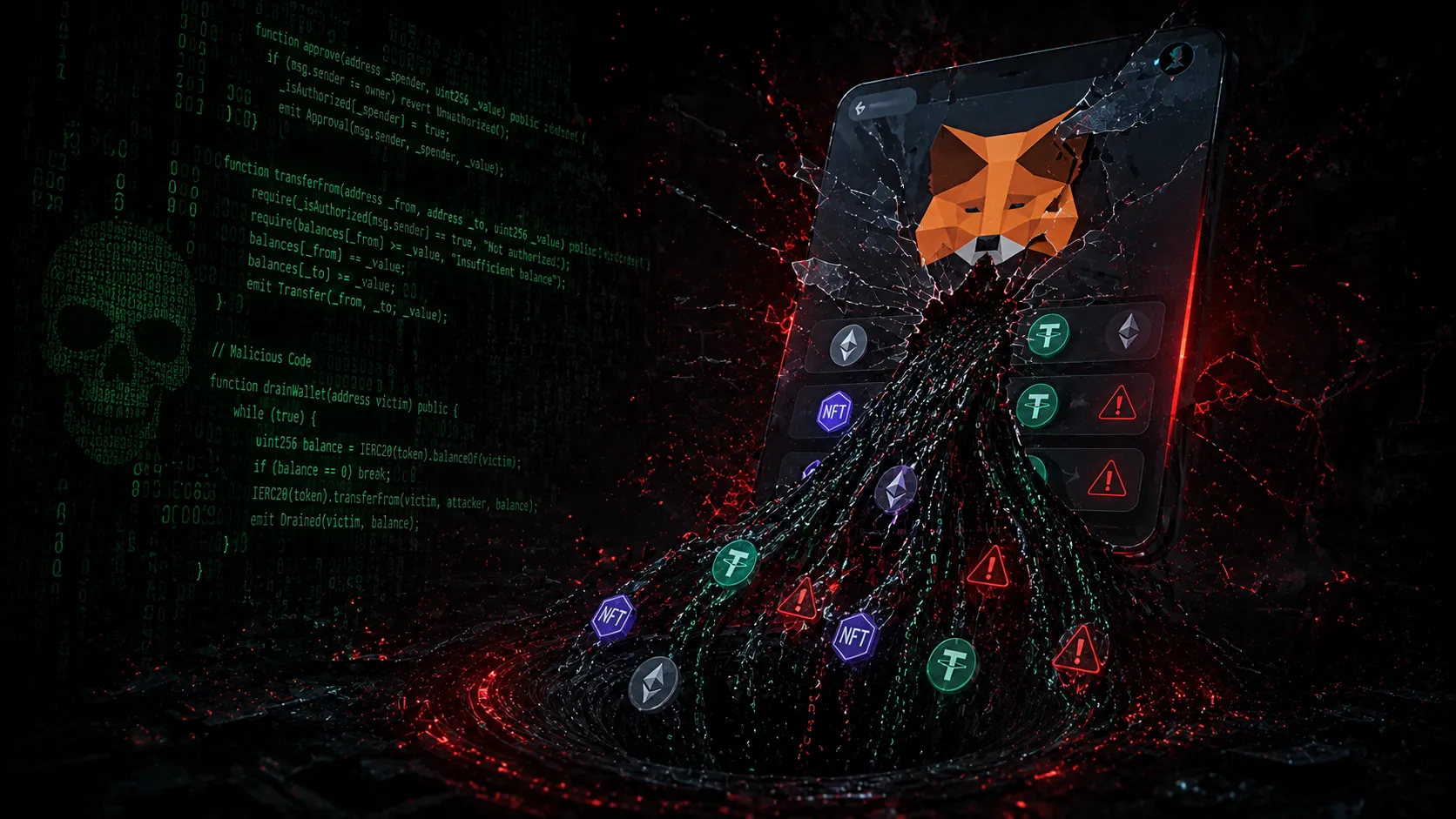
Drainer contracts are typically sold as "drainer-as-a-service" on underground markets — complete packages with a phishing site template, a drainer smart contract, and a dashboard showing victim wallets and drained amounts. Operators pay 20–30% of stolen funds to the drainer developer. Here's a simplified example of what a malicious approval interaction looks like on-chain:
The entire sequence — approval and drain — often completes within 2–3 blocks (under 1 minute on Ethereum). By the time the victim realises what happened, funds have typically already been bridged or mixed.
Forensic Reconstruction of Drainer Attacks
Despite the speed of drainer attacks, the on-chain evidence is extremely rich. Blockchain forensics can reconstruct the full attack with high precision:
Identify the Malicious Approval Transaction
The exact block and timestamp when the approval was granted. This becomes the legal threshold — any value transferred after this point by the drainer is attributable to the attack. The approval transaction also links to the drainer smart contract address.
Analyse the Drainer Contract
Smart contract code is immutable and publicly readable on the blockchain. We decompile the drainer contract to understand its full capabilities, identify the developer's wallet (often receives a percentage of each drain), and link it to other victims of the same drainer service — often numbering in the hundreds.
Trace Post-Drain Fund Movement
Drained funds are typically immediately consolidated and moved. We trace the full graph: drainer wallet → aggregation wallet → bridge (cross-chain transfer) → destination chain address. Cross-chain tracing through bridges like Stargate, Synapse, and LayerZero uses amount-timing correlation to re-identify funds on the destination chain.
Exchange Attribution
The ultimate goal is identifying any point where stolen tokens were deposited to a KYC-regulated exchange. Our exchange intelligence service sends targeted preservation requests to 40+ exchanges, supported by the forensic trace report, requesting voluntary account freezes pending legal process.
Cross-Victim Clustering
Individual drainer cases are often part of large operations targeting hundreds of victims simultaneously. We aggregate data across victims to build a comprehensive picture of the criminal infrastructure, which dramatically increases law enforcement priority and legal leverage.
Revoking Malicious Approvals — Critical First Step
If you have granted a malicious approval but your tokens haven't been drained yet, revocation is your most urgent priority. Use a token approval checker and revocation tool:
- Revoke.cash — Supports Ethereum, Polygon, BNB Chain, Arbitrum, Optimism, and most EVM chains. Shows all active approvals and allows one-click revocation.
- Etherscan Token Approval Checker — For Ethereum specifically. Navigate to etherscan.io, connect your wallet, and review active approvals under the token approval checker tool.
- Wallet-native revocation — MetaMask, Rabby, and other wallets increasingly include built-in approval management. Check your wallet's settings or security section.
Never sign an approval request from a website you didn't deliberately navigate to. Before signing any transaction, verify the exact contract address being approved against the legitimate protocol's official documentation. Use a hardware wallet (Ledger, Trezor) for significant holdings — the physical confirmation step forces review of every transaction. Avoid "unlimited" approvals even on legitimate platforms: always set specific spending amounts.
Recovery Options After a Drainer Attack
Recovery from a wallet drainer attack is challenging but not impossible, particularly if action is taken quickly:
- Exchange freezes: If any portion of drained funds reached a regulated exchange before you filed a report, compliance-backed notifications can freeze those funds pending legal action. Time is critical — exchanges typically cannot action requests for funds that have already been withdrawn.
- Civil legal action: In jurisdictions with crypto-competent courts, civil freeze orders (Norwich Pharmacal orders in the UK, John Doe subpoenas in the US) can compel exchanges to disclose the identity of account holders who received stolen funds.
- Law enforcement reports: A detailed forensic report dramatically increases the quality of your law enforcement submission. For large losses (>$50K), direct contact with FBI Cyber Division or EUROPOL EC3 is worthwhile.
- Bug bounties and protocol funds: For cases involving protocol exploits (rather than individual phishing), some DeFi protocols maintain security funds that compensate victims of successful exploits — particularly if the victim can demonstrate the attack exploited a flaw in the protocol itself rather than user error.
Wallet Drained? Fast Response Matters.
Our forensics team can trace drainer attacks within hours, with emergency response available 24/7. Tell us what happened and we'll tell you what's traceable.
Emergency Response