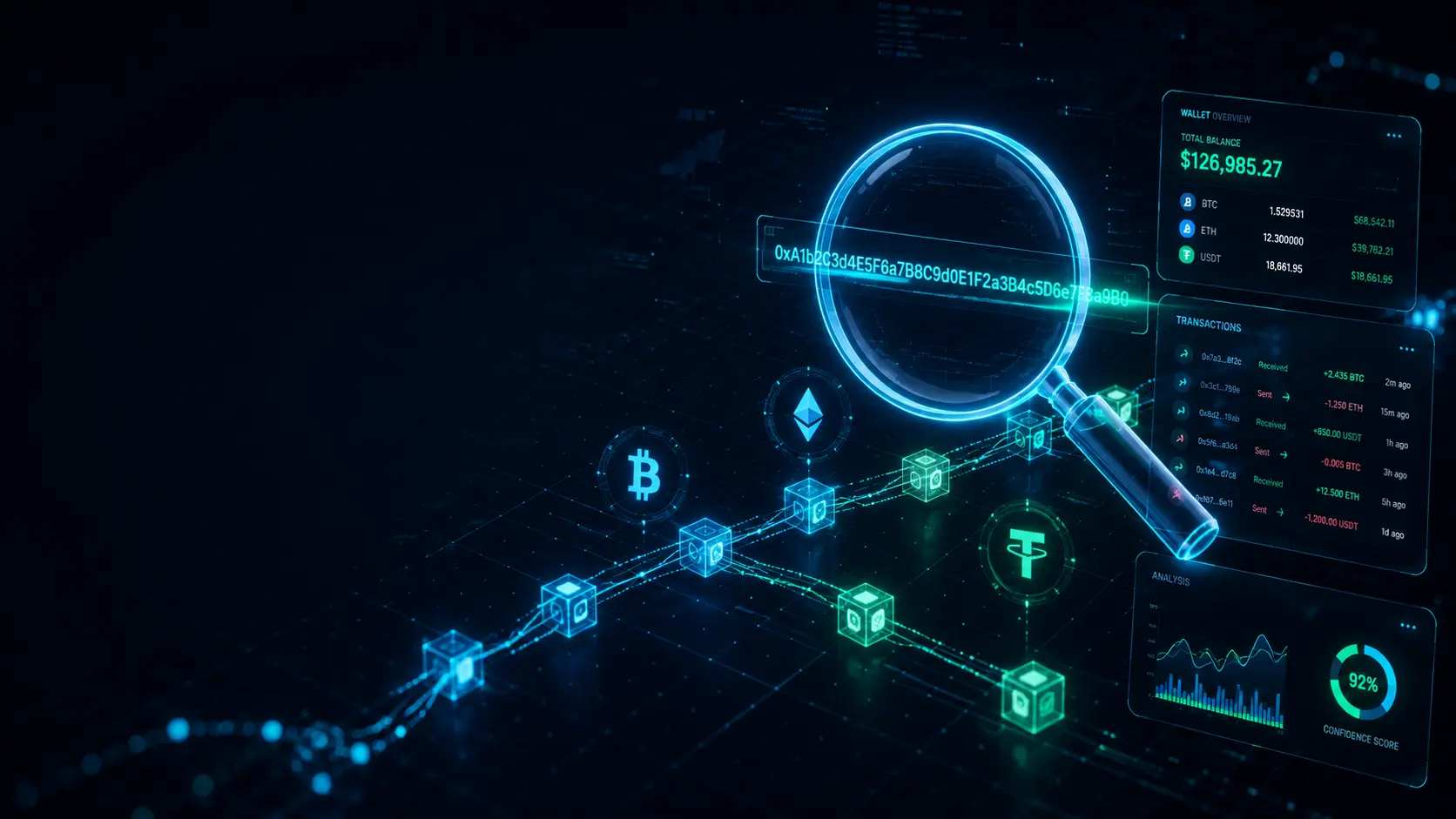
To check whether a crypto wallet address is a scam, identify the network (BTC, ETH, BNB or TRON), run a free wallet check to see its balance, transaction count and recent activity, then look for red flags: many small deposits from different victims, funds that leave within minutes, draining to zero, or links to flagged addresses. Use our free Wallet Check tool to look up any address in seconds — no signup, no fee.
Before you send funds to an address, accept a "guaranteed return" offer, or chase money that's already gone, you can — and should — check the wallet address first. Every public blockchain is a permanent, open ledger, which means anyone can inspect an address's balance and history for free. This guide shows you exactly how to check a crypto wallet address, what scam red flags to look for, and what to do next if the address turns out to be linked to fraud.
🔍 Check Any Wallet Address — Free
Look up live balance, transaction count and recent activity for any Bitcoin, Ethereum, BNB Chain or TRON (USDT) address. No account, no fee, no waiting.
Open the Free Wallet CheckWhy Checking a Wallet Address Matters
Crypto transactions are irreversible. Once you send funds to a scammer's address, there is no chargeback and no "undo" button. That makes a 30-second wallet check one of the highest-value habits in crypto. A quick lookup can tell you whether an address is brand new, whether it's already received money from dozens of other people, or whether funds are being swept out the moment they arrive — all classic patterns of fraud.
There are two situations where people check an address: before sending money (due diligence on a seller, platform, or "investment manager"), and after a loss (confirming where stolen funds went). Both are valid, and both start with the same free lookup.
Step 1 — Identify Which Blockchain the Address Belongs To
Addresses look different on each network, and you need to query the right blockchain. Here's how to tell them apart at a glance:
| Network | Address looks like | Notes |
|---|---|---|
| Bitcoin (BTC) | 1..., 3... or bc1... | Native Bitcoin. "bc1" is a modern SegWit address. |
| Ethereum (ETH / ERC-20) | 0x + 40 hex characters | Also used by most ERC-20 tokens (USDT, USDC). |
| BNB Chain (BSC) | 0x + 40 hex characters | Same format as Ethereum — the network differs, not the address shape. |
| TRON (TRC-20 / USDT) | T... (34 characters) | The most common rail for USDT in scams worldwide. |
Ethereum and BNB Chain share the exact same address format. If a lookup on one shows no activity, try the other network — the funds may simply live on the other chain. Our free tool lets you pick the network so you check the right ledger.
Step 2 — Run a Free Wallet Check
You don't need expensive software to read a public blockchain. Our free Wallet Check tool queries the live ledger and returns the essentials in seconds:
- Current balance — how much the address holds right now
- Transaction count — how active the address has been overall
- Recent activity — the most recent movements in and out
- First and last seen — how new or established the address is
It's read-only and completely safe: you only ever enter the public address, never a private key or seed phrase. The tool simply asks the blockchain what it already knows publicly.
Step 3 — Read the Red Flags
A wallet check gives you raw data; interpreting it is what reveals a likely scam. Here are the patterns investigators look for:
Many Small Deposits From Many Wallets
A "collection" address that receives lots of similar-sized incoming transfers from dozens of unrelated wallets often indicates a fraud operation pooling money from multiple victims.
Funds Arrive and Leave Within Minutes
Legitimate wallets hold balances. Scam wallets are usually pass-through: money lands and is swept onward to the next hop almost immediately to frustrate tracing and freezing.
Drained to Zero
An address that received significant funds and now holds nothing — especially one created recently — is a strong sign of a cash-out operation rather than a personal wallet.
Links to Flagged or Sanctioned Addresses
If the wallet interacts with addresses already known for scams, mixers, or appearing on sanctions lists, that's a serious warning. Confirming this attribution is where professional forensics goes beyond a public lookup.
Scammers rotate addresses constantly, so a brand-new wallet with little history can still belong to a fraud operation. A public check is a powerful first filter, but the absence of red flags is not proof of safety. When real money is at stake, verify before you send.
The Golden Rule: Never Share Your Private Key
Checking an address is safe because the address is public. Your private key and seed phrase are not. No legitimate wallet checker, support agent, exchange, or "recovery expert" will ever need them. If any tool or person asks you to enter your seed phrase to "verify," "sync," or "unlock" funds, it is a scam — close it immediately.
Step 4 — If the Wallet Took Your Money: What to Do Now
If your check confirms funds went to a scam wallet, the next 24–72 hours matter enormously. The blockchain's permanence works in your favour — every movement is recorded forever — but exchanges can only freeze funds that are still sitting in an account they control. Speed is everything.
Cases reported within the first few days have meaningfully higher recovery rates. The moment stolen funds reach an exchange, a timely freeze request can stop the cash-out — but only if the trace and report happen fast.
- Preserve evidence: Screenshot the scam address, the transaction hashes (TXIDs), amounts, timestamps, and any messages from the scammer. Don't delete anything.
- Stop further transfers: Never pay an additional "fee," "tax," or "unlock" amount to recover funds — that is a secondary scam.
- Engage blockchain forensics: Professional tracing follows the funds across wallet hops, mixers, and bridges to an identifiable exchange or cash-out point.
- File reports: Report to your national cybercrime body (FBI IC3, Action Fraud, ASIC, MAS, and similar) with your evidence package.
- Request exchange freezes: With a forensic report identifying the destination exchange, a freeze request can lock the funds before withdrawal.
For the full playbook, see our guide on how to recover stolen cryptocurrency and our step-by-step breakdown of the first 48 hours after a crypto theft.
DIY Check vs. Professional Forensics
A free wallet check answers "what does this address show publicly?" Professional blockchain tracing answers "where did the money actually go, who controls it, and how do we get it frozen?" The difference is attribution and reach:
- What you can do free: Confirm a balance, see activity, spot obvious pass-through behaviour, and gather first evidence.
- What forensics adds: Cross-hop tracing through mixers and bridges, clustering wallets to real entities, identifying the exchange endpoint, and producing a court-admissible report that supports freeze requests and legal action.
Most successful recoveries combine both: the victim checks the address, preserves evidence, and then hands a professional team a head start.
Frequently Asked Questions
Can I check a crypto wallet address for free?
Yes. Public blockchains are transparent, so any address can be looked up at no cost. Our free Wallet Check tool returns balance, transaction count, and recent activity for BTC, ETH, BNB Chain, and TRON (USDT) with no signup.
How do I know if a wallet address is a scam?
Look for high volumes of small incoming deposits from many wallets, funds that leave within minutes, draining to zero, and links to already-flagged addresses. These patterns strongly suggest fraud, though confirmation requires forensic attribution.
Is it safe to enter a wallet address into a checker?
Yes — an address is public. Never enter your private key or seed phrase anywhere. A legitimate checker only asks for the public address.
Can stolen crypto be recovered after I check the wallet?
Checking is step one. If funds are traceable to a regulated exchange and you act quickly, a forensic trace plus a freeze request and law-enforcement report can lead to meaningful recovery.
Conclusion: Check First, Then Act Fast
Checking a wallet address takes seconds and can save you from an irreversible mistake — or give you the first solid evidence in a recovery case. Identify the network, run a free lookup, read the red flags, and never share your private key. If the address is tied to a loss, move quickly: preserve evidence and engage professional forensics while a freeze is still possible.
Start with the free check, and if something looks wrong, talk to our investigators — we operate 24/7 and trace across 50+ networks.
Checked a Wallet and Something's Wrong?
Run the free check first — then let our investigators trace the funds. 90-minute response, 24/7, across 50+ networks.